Fiber Optic Cabling Installation in South Texas
When copper cabling reaches its limits — whether in distance, bandwidth, or electromagnetic interference — fiber optic cabling is the answer. Businesses, campuses, healthcare systems, and industrial facilities throughout South Texas rely on fiber to connect buildings, link data centers, support high-throughput applications, and future-proof their network infrastructure for decades to come.
Punchdown Communications designs and installs single-mode and multimode fiber optic cabling systems across all of South Texas, including San Antonio, McAllen, Brownsville, Harlingen, Laredo, Corpus Christi, Edinburg, Mission, Del Rio, Eagle Pass, Alice, Victoria, Pharr, Weslaco, and all communities throughout the Rio Grande Valley and South Texas Plains.
Contact Punchdown Communications today to discuss your fiber optic cabling project and receive a free site assessment.
Single-Mode vs. Multimode Fiber — Choosing the Right Specification
Fiber optic cabling is not a single product. The two primary categories — single-mode and multimode — serve different applications, transmission distances, and budget profiles. Selecting the correct fiber type at the planning stage prevents costly replacements down the road.
Single-Mode Fiber (SMF)
Single-mode fiber uses a much narrower core diameter (typically 9 microns) that allows light to travel in a single propagation path. This eliminates modal dispersion, enabling transmission over extremely long distances — often several kilometers or more — with minimal signal loss. Single-mode fiber is the standard specification for campus backbone connections, inter-building links, and any run where distance is a primary factor.
Multimode Fiber (MMF)
Multimode fiber carries multiple light paths simultaneously through a larger core (50 or 62.5 microns), making it well-suited for shorter distances within a building or between equipment in the same facility. OM3 and OM4 multimode fiber supports 10 Gbps at distances up to 300 and 400 meters respectively, while OM5 extends multimode capability to support shortwave division multiplexing (SWDM) for 40G and 100G applications.
Fiber Optic Installation Services Provided by Punchdown Communications
Punchdown Communications handles every phase of a fiber optic cabling project from initial design through post-installation certification.
Fiber Pulling and Pathway Installation
Fiber optic cable requires careful handling during installation. Unlike copper, it cannot be kinked, over-bent, or subjected to excessive pulling tension without risking damage to the glass strand inside. Punchdown Communications uses proper pulling equipment, innerduct protection, and bend-radius-compliant hardware throughout every installation.
Termination — Connectors and Splice Enclosures
Fiber runs are terminated using factory-polished connectors (LC, SC, ST, and MPO/MTP depending on application) or through fusion splicing, where two fiber ends are permanently joined by precisely melting them together with an electric arc. Fusion splicing produces the lowest-loss connection method available and is the standard for backbone and long-distance runs.
OTDR Testing and Certification
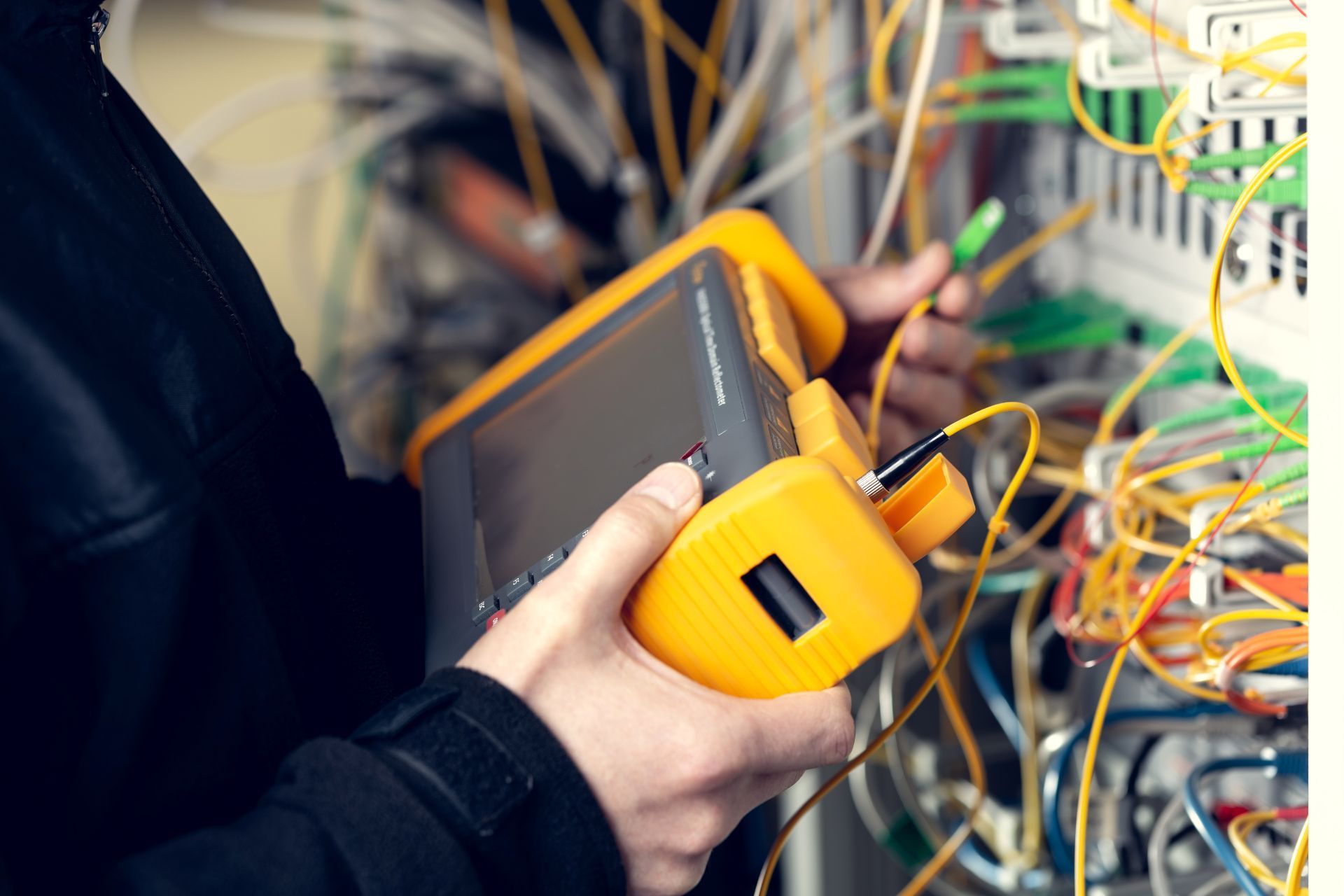
Every completed fiber installation is tested with an Optical Time Domain Reflectometer (OTDR). The OTDR sends a light pulse down the fiber and analyzes the reflections to identify splice losses, connector losses, breaks, and the precise location of any faults along the entire length of the run. Results are documented in a full certification report delivered with the project.
Reach out to Punchdown Communications to schedule a fiber optic consultation for your South Texas business, campus, or facility.
Applications for Fiber Optic Cabling Across South Texas
Campus and Multi-Building Networks
Universities, school districts, hospital campuses, and corporate parks across South Texas use single-mode fiber to interconnect buildings across parking lots, open grounds, and underground conduit systems. Fiber eliminates the distance and grounding limitations that make copper impractical for inter-building connections.
Data Centers and Server Rooms
High-density data center environments require cabling that can support 10G, 40G, and 100G switch interconnects within the same physical footprint. Multimode OM4 or OM5 fiber paired with MPO/MTP trunk cables and pre-terminated cassettes provides the high-density, low-loss backbone that modern data center architectures demand.
Industrial and Border Corridor Facilities
South Texas hosts a significant concentration of manufacturing, logistics, and international trade infrastructure, particularly along the US-Mexico border in Laredo, Eagle Pass, and Brownsville. Fiber optic cabling is completely immune to EMI, making it the only reliable high-speed cabling option in environments with heavy electromagnetic interference from motors and welding equipment.
Outdoor and Direct-Buried Fiber Optic Cabling
Connecting separate buildings on the same property — or running fiber between structures across a parking lot, along a fence line, or underground — requires outdoor-rated fiber cable engineered for environmental exposure. Punchdown Communications installs armored outdoor fiber, direct-buried gel-filled cable, and aerial fiber on messenger strand depending on the pathway, distance, and physical conditions of the site.
South Texas presents specific environmental considerations including heat, humidity, and in coastal areas near Corpus Christi and the lower Rio Grande Valley, salt air exposure — all of which Punchdown Communications accounts for in outdoor fiber design and product selection.
Get in touch with Punchdown Communications to plan your South Texas fiber optic cabling project — from single inter-building runs to full campus backbone installations.
FAQ"S
Frequently Asked Questions About Fiber Optic Cabling in South Texas
What is the maximum distance fiber optic cable can run without a signal repeater?
Single-mode fiber can transmit data over distances of 10 kilometers or more without amplification, depending on the wavelength and transceiver specifications in use. Multimode fiber is typically used for runs up to 300 to 550 meters depending on the fiber grade and network speed.
Is fiber optic cabling faster than Cat6A copper?
Both fiber and Cat6A copper can support 10 Gbps in typical structured cabling configurations. The meaningful difference is in distance, scalability, and future capacity. Fiber supports 40G, 100G, and beyond using the same physical cable by upgrading transceivers, while copper's maximum practical throughput is capped at 10 Gbps at 100 meters.
Can fiber optic cable be damaged by lightning or electrical surges?
Glass fiber strands carry no electrical current and are therefore completely immune to lightning-induced voltage surges and ground potential differences between buildings. This makes fiber the preferred medium for inter-building connections in environments where copper's vulnerability to surge damage creates reliability or safety concerns.
What types of fiber connectors does Punchdown Communications install?
Punchdown Communications installs LC, SC, ST, and MPO/MTP fiber connectors depending on the application. LC connectors are standard for most modern switches and patch panels. SC connectors remain common in older infrastructure. MPO/MTP connectors are used in high-density data center and 40G/100G backbone applications.
What is fusion splicing and when is it used?
Fusion splicing is the process of permanently joining two fiber optic strands by precisely aligning them end-to-end and melting them together with an electric arc. The result is a nearly seamless connection with insertion loss typically below 0.1 dB. Fusion splicing is used for backbone runs, long-distance links, and any application where minimizing signal loss is a priority.
How do I know if my facility needs single-mode or multimode fiber?
The primary factors are distance and application. If you are connecting equipment within the same building over distances under 300 to 550 meters, multimode is typically the more cost-effective choice. If you are connecting separate buildings or supporting runs over several hundred meters, single-mode is the correct specification.
Does Punchdown Communications provide OTDR test reports with every installation?
Yes. Every fiber installation completed by Punchdown Communications is tested with an OTDR and the results are documented in a certification report delivered to the client at project closeout. This report serves as a baseline performance record for the fiber plant.
Can existing copper infrastructure be upgraded to fiber without a full rewire?
In most cases, fiber is added as a new backbone layer while existing copper horizontal cabling remains in place for workstation connections. The fiber backbone connects equipment rooms, server rooms, and distribution points, while copper continues to serve individual drops at the edge.
How long does a fiber optic installation take?
A single inter-building fiber run between two structures may be completed in a single day. A multi-building campus fiber installation with multiple splice points and outdoor conduit sections may take several days to a week or more. Punchdown Communications provides a detailed project timeline during the proposal phase.
What areas of South Texas does Punchdown Communications serve for fiber optic cabling?
Punchdown Communications serves all of South Texas for fiber optic cabling installation, including San Antonio, McAllen, Laredo, Corpus Christi, Brownsville, Harlingen, Edinburg, Mission, Del Rio, Eagle Pass, Alice, Victoria, Pharr, Weslaco, Mercedes, and all surrounding communities throughout the Rio Grande Valley and South Texas Plains region.