
Commercial Cable Management in South Texas
Disorganized cabling infrastructure is more than an eyesore. Unlabeled cables, overcrowded patch panels, unsupported runs sagging across ceiling spaces, and equipment rooms packed with tangled wiring create real operational consequences — longer troubleshooting times, higher risk of accidental disconnections during routine maintenance, reduced airflow in equipment racks, and an infrastructure that nobody on your team fully understands. Punchdown Communications provides professional commercial cable management services for businesses, healthcare facilities, educational institutions, data centers, and government offices throughout South Texas, including San Antonio, McAllen, Corpus Christi, Laredo, Brownsville, Harlingen, Edinburg, Mission, Del Rio, Eagle Pass, Alice, Victoria, Pharr, Weslaco, and every community across the Rio Grande Valley and South Texas Plains.
Contact Punchdown Communications today to schedule a cable management assessment for your South Texas facility.
What Professional Cable Management Actually Involves
Horizontal Cable Management in Equipment Racks
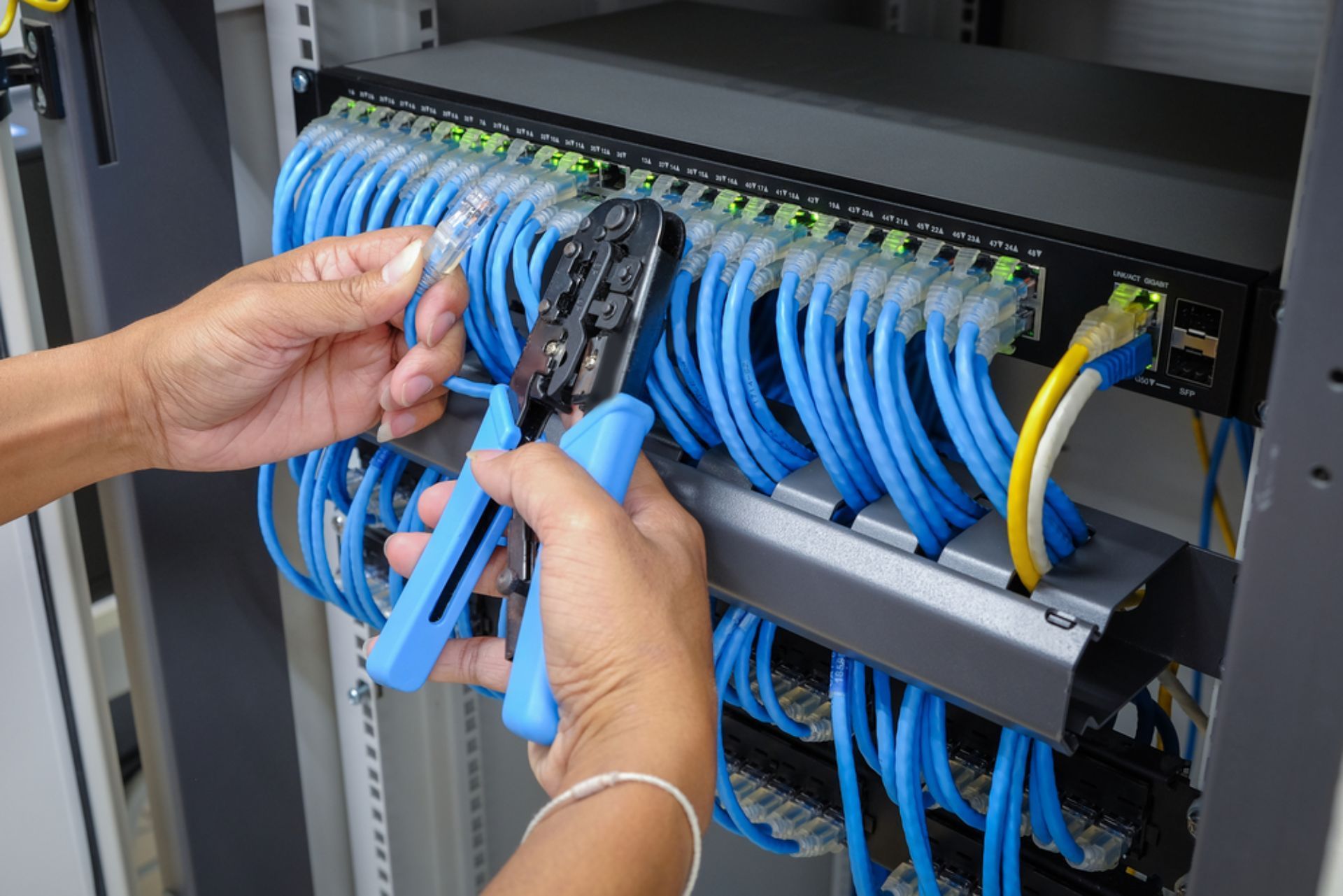
Horizontal cable managers route patch cords cleanly from panel ports to switch ports without creating the cascading tangles that accumulate over time in racks without proper management hardware. Punchdown Communications installs horizontal managers at every patch panel and switch row, maintaining consistent slack loops and bend radius compliance at every connection point.
Vertical Cable Management and Rack Organization
Vertical cable managers on the sides of equipment racks handle the longer runs of patch cord and structured cabling that travel between rack units separated by significant vertical distance. Proper vertical management prevents cables from hanging across the front of equipment, blocking airflow, obscuring port labels, and creating the weight-induced stress on connectors that causes intermittent connectivity problems over time.
Overhead Cable Tray and J-Hook Systems
Above the ceiling, cable tray and j-hook support systems provide organized pathways for structured cabling runs between equipment rooms and device locations throughout the facility. Punchdown Communications installs and organizes overhead cable infrastructure with consistent support spacing, separation between different cable system types, and bend radius compliance at every direction change.
Cable Management for Existing Infrastructure — Remediation Projects
Assessment and Inventory
Every cable management remediation project begins with a complete assessment of the existing infrastructure. Punchdown Communications documents what is currently installed — identifying every active connection, every abandoned cable that is no longer connected to anything, every unlabeled run, and every physical management deficiency in the equipment room and throughout the cable pathways.
Abandoned Cable Removal
Abandoned cables accumulate in commercial cabling infrastructure over time and create real problems — consuming pathway capacity, adding weight to cable support systems, restricting airflow in plenum spaces, and creating visual clutter that makes active cabling harder to identify. Punchdown Communications removes abandoned cabling as part of remediation projects.
Labeling and Documentation
Unlabeled cabling infrastructure is unmanaged cabling infrastructure. Punchdown Communications labels every cable at both ends using a consistent, logical identification scheme and creates the corresponding documentation — patch panel schedules, cable run records, and equipment room diagrams.
Patch Cord Replacement and Standardization
Punchdown Communications replaces patch cord inventories with correctly sized, color-coded cords that match port assignments and maintain clean, organized connections throughout the rack. Mismatched lengths create excess slack that fills the rack with unnecessary bulk, while undersized patch cords pull tight against connectors and introduce stress that degrades performance over time.
Reach out to Punchdown Communications to discuss a cable management remediation project for your South Texas equipment room or facility.
Cable Management Standards and Best Practices
TIA-569 Pathway and Spaces Standard
The TIA-569 standard governs the design of pathways, spaces, and cable support systems in commercial buildings. It specifies minimum bend radius requirements for different cable types, maximum cable fill ratios for conduit and cable tray, support spacing for j-hook and cable tray systems, and telecommunications room size and layout requirements.
Bend Radius and Fill Ratio Compliance
Exceeding the minimum bend radius of a cable — forcing it to turn too sharply at a corner or through a cable manager — permanently degrades its performance by deforming the internal geometry of the cable. Punchdown Communications maintains correct bend radius at every direction change throughout the cable pathway.
Schedule your commercial cable management project with Punchdown Communications — serving businesses and facilities across all of South Texas.
FAQ"S
Frequently Asked Questions About Commercial Cable Management in South Texas
Why does cable management matter for network performance, not just appearance?
Cable management directly affects network performance in several specific ways. Cables forced through tight bends suffer permanent performance degradation. Cables piled in dense bundles can experience signal interference. Cables without proper support create tension at termination points causing intermittent connectivity problems.
How long does a cable management remediation project typically take?
A single equipment room remediation for a small office may be completed in one day. A multi-room remediation involving several telecommunications rooms and complete labeling across several hundred cable runs may take several days to a week. Punchdown Communications provides a detailed project timeline based on the actual scope of work.
Can cable management work be done without taking the network offline?
Yes, in most cases. Punchdown Communications plans cable management remediation to maintain active network connections throughout the process, working in sections and maintaining all active connections until replacement connections are verified before the original is disturbed.
What is the difference between cable management hardware and cable management practice?
Cable management hardware refers to the physical products — horizontal and vertical cable managers, cable tray, j-hooks, and velcro straps. Cable management practice refers to how those products are used — maintaining consistent slack loops, correct bend radius, logical routing, and systematic labeling throughout the installation.
Should zip ties or velcro straps be used to bundle network cables?
Velcro straps are the correct choice for bundling network cables in equipment racks and telecommunications rooms. Zip ties, when overtightened, compress the cable jacket and deform the internal geometry of the twisted pairs — a condition that permanently degrades cable performance. Punchdown Communications uses velcro straps throughout equipment room installations.
What should a properly organized telecommunications room include?
A well-organized telecommunications room includes structured patch panels with horizontal cable managers between every panel row, clearly labeled patch panels and field terminations, vertical cable managers routing patch cords between panels and switches, properly supported horizontal cabling entering the room through sleeves or cable managers, and a documented patch schedule that maps every panel port to its corresponding field location.
How does cable management affect troubleshooting time and IT support costs?
In a disorganized cabling environment, identifying a specific cable run requires physical tracing through a tangle of other cables. In a properly managed and labeled environment, identifying a cable takes seconds rather than minutes or hours. The accumulated time savings from faster troubleshooting represents a significant reduction in IT support costs over the life of the infrastructure.
Does Punchdown Communications provide cable management for outdoor and industrial cabling environments?
Yes. Cable management in outdoor and industrial environments across South Texas requires weather-resistant cable tray, UV-rated conduit and fittings, stainless steel hardware in coastal environments near Corpus Christi and the lower Rio Grande Valley, and sealing systems that prevent moisture intrusion at all conduit entries.
What documentation does Punchdown Communications provide after a cable management project?
Every cable management project includes a complete documentation package at closeout, containing updated cable run records, patch panel port schedules mapping field terminations to switch ports, equipment room diagrams reflecting the organized layout as installed, and any certification test records for cabling that was retested as part of the remediation.
What South Texas areas does Punchdown Communications serve for commercial cable management?
Punchdown Communications provides commercial cable management services throughout all of South Texas, including San Antonio, McAllen, Laredo, Corpus Christi, Brownsville, Harlingen, Edinburg, Mission, Del Rio, Eagle Pass, Alice, Victoria, Pharr, Weslaco, Mercedes, and all surrounding communities.